You don’t need a different shoe for every workout anymore.
Most sessions now mix lifting, plyometrics, and short cardio bursts, and single-purpose shoes just can’t keep up. That’s where modern cross-training shoes shine. They’re built for the blend.
Today’s designs balance cushioning and stability, with responsive midsoles, durable yet lightweight uppers, and roomier toe boxes for better footing under load.
Whether you’re doing CrossFit, HIIT, or a mix of strength and cardio, one good pair can handle it all.
Best Cross Training Shoes for Lifting, HIIT, CrossFit, and Everything in Between
The seven shoes below cover the full range of training styles, from a maximum-stability lifting platform for barbell-focused athletes to an ultra-lightweight minimalist option built for speed and agility work.
Each was chosen based on real-world performance across multiple movement patterns, midsole durability under load, and how well the construction matches a specific training priority.
1. Nike Metcon 10
The best for CrossFit and competitive training

The Metcon’s design philosophy hasn’t changed because it doesn’t need to: a stiff, stable heel platform for heavy lifts, a low-profile feel that stays out of the way during technical movements, and enough forefoot flexibility to handle burpees and box jumps without fighting the shoe.
The Metcon 10 refines all three. The updated Hyperlift plate in the heel is stiffer than the previous generation for squat and deadlift stability, and the active-flex zones in the forefoot make the transition from a clean to a burpee feel less abrupt than on earlier Metcon versions.
Rope grip on the lateral wrap is among the best in the category.
The rubber extends far enough up the side of the shoe to protect the midsole during hook grips, which is the kind of durability detail that matters after six months of regular CrossFit use.
The trade-off is ride firmness. The Metcon 10 is not a comfortable shoe for running, and anyone programming long conditioning runs into their training will feel that on anything over a mile.
Type: Stability specialist | Specs: 4mm drop, 12.1 oz, reinforced mesh upper, dual-density foam
Pros:
- The Hyperlift heel plate provides the stiffest, most stable lifting platform on this list. Direct force transfer into the floor for squats, deadlifts, and Olympic lifts
- Lateral rope wrap handles regular rope climb sessions without the midsole damage that ends the lifespan of less reinforced trainers
- Low 4mm drop keeps the center of gravity close to the floor for heavy barbell movements
Cons:
- Firmest ride on this list. Impact feedback during running makes it uncomfortable for distances beyond a mile
- 12.1 oz is the heaviest option here, which adds up during high-rep conditioning pieces
Verdict: The clearest choice for CrossFit athletes whose training is primarily barbell-focused. If your workouts are 80% lifting and the rest is short conditioning work, nothing on this list offers a better platform.
2. Reebok Nano X5
The best overall cross-training shoe

The Nano has been the default recommendation for hybrid athletes for years, and the X5 earns that position by addressing the one area where previous versions fell short: running feel.
The Floatride Energy+ foam in the forefoot is genuinely responsive for a training shoe: sprint intervals and shuttle runs feel less punishing than on stiffer competitors, without softening the heel platform to the point where it becomes unstable under a heavy squat.
The KnitPro 2.0 upper handles rope climbs without the medial wear that destroys standard mesh uppers within a few months of regular CrossFit use.
The fit accommodates slightly wider feet without sacrificing midfoot lockdown, and the overall weight stays low enough that the shoe doesn’t become a liability in long conditioning pieces.
Type: Hybrid trainer | Specs: 7mm drop, 11.2 oz, KnitPro 2.0 upper, Floatride Energy+ foam
Pros:
- Floatride Energy+ forefoot foam makes this the most run-friendly trainer on the list; it handles distances up to 3 miles without the impact feedback that stiffer shoes produce
- Medial rope wrap resists the friction damage that shreds standard uppers during rope climbs. Holds up significantly longer than non-reinforced competitors
- 7mm drop works well across strength, plyometric, and running demands without being optimized for just one
Cons:
- Fit runs slightly wide. Athletes with narrow feet may find less lateral lockdown than the Metcon or NOBULL provides
Verdict: The most balanced cross-training shoe available right now. If your training routine spans lifting, cardio, and skill work in the same session and you want one shoe that handles all of it, the Nano X5 is the reliable answer.
3. Adidas Dropset 3
The best for stability and heavy lifting

Most lifting shoes solve the stability problem by making the entire midsole as hard as possible, which works under a barbell but feels punishing during accessory work.
The Dropset 3’s dual-density midsole takes a more precise approach: the heel is firm enough to prevent compression under heavy load, while the forefoot is softer for natural movement during lunges, step-ups, and box jumps.
The result is a shoe that handles a heavy squat session followed by accessory hypertrophy work without requiring a shoe change between the two.
The heat-mapped recycled mesh upper channels airflow through the zones that generate the most heat during heavy lifting sessions (the medial and lateral midfoot) rather than applying ventilation uniformly across the upper, where it matters less.
The Traxion outsole’s wide base creates a large ground contact area that experienced lifters will immediately recognize as the “planted” feeling that narrow-based shoes can’t replicate.
Type: Lifting-focused hybrid | Specs: 6mm drop, 11.8 oz, recycled heat-mapped mesh, Traxion outsole
Pros:
- Dual-density midsole keeps the heel firm for barbell stability while allowing forefoot flexibility for accessory and hypertrophy movements
- Wide Traxion outsole base creates maximum ground contact for heavy squats and deadlifts. The broadest lifting platform on this list
- Heat-mapped mesh ventilation channels airflow through the areas that overheat during sustained lifting sessions
Cons:
- Bulkier silhouette than the Nano and Metcon. Not a shoe that transitions well into cardio or agility-heavy workouts
- Heel stiffness becomes a liability during high-repetition jumping movements, where the foot needs more forefoot rebound
Verdict: The best shoe for athletes who train primarily in the strength and hypertrophy rep ranges and want a lifting-focused platform that still handles accessory movement work without switching shoes.
4. NOBULL Trainer+
The best premium performance and durability
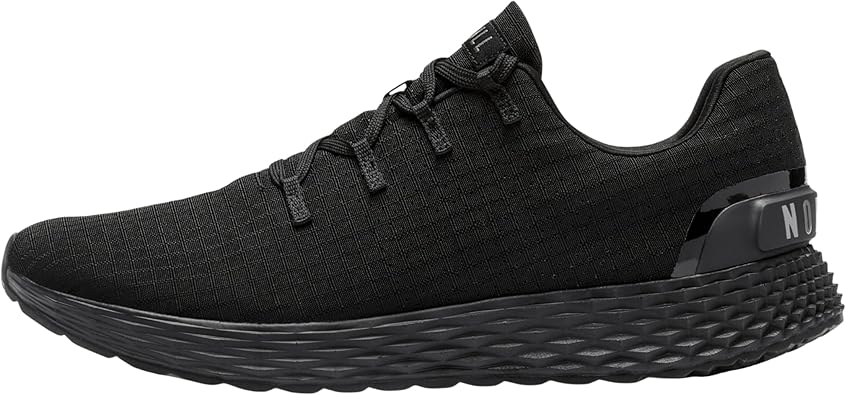
NOBULL built its reputation on one claim: the shoe won’t fall apart.
The SuperFabric upper on the Trainer+ backs that up; the material resists tearing, abrasion, and the kind of surface contact damage that degrades standard mesh uppers in months.
The 2026 Plus model adds an upgraded herringbone outsole pattern that provides better traction on both turf and rubber gym floors than the previous version, which was already strong.
The design is deliberately minimal. There’s no nitrogen foam, no adaptive cushioning system, and no proprietary stability plate. The high-rebound EVA handles impact without the progressive softening that more complex foam compounds sometimes show after heavy use.
For athletes who want a flat, simple, durable shoe that performs consistently over a long lifespan rather than maximizing one specific metric, the Trainer+ is the clearest option on this list.
Type: Rugged minimalist | Specs: 4mm drop, 10.9 oz, SuperFabric upper, high-rebound EVA midsole
Pros:
- SuperFabric upper resists tearing and abrasion from rope climbs, turf training, and high-contact surface work. The most durable upper material on this list
- Upgraded herringbone outsole provides reliable traction on gym rubber, turf, and outdoor surfaces without the grip degradation of softer rubber compounds
- Clean aesthetic works as a daily wear shoe. The premium materials hold up outside the gym without looking like training equipment
Cons:
- Price reflects the material quality, but sits above similarly performing shoes with more basic construction
- Midsole cushioning is minimal compared to the Nano X5 and Reebok options. Impact protection during jumping and running is noticeably lower
Verdict: Worth the price if durability over a long training lifespan matters more than maximum cushioning technology. Athletes who train hard five or six days a week and replace shoes frequently will find the Trainer+ lasts significantly longer than comparably priced alternatives.
5. Under Armour TriBase Reign 6
The best stability and ground connection

The TriBase geometry is designed around a specific theory: distributing ground contact across three points of the foot produces better stability for lateral movement than a single continuous outsole.
In practice, the Reign 6 feels more planted during lateral drills, kettlebell swings, and agility work than shoes with conventional flat outsoles. The contact distribution reduces the micro-adjustments the foot makes to compensate for uneven weight transfer during side-to-side movement.
The Reign 6 is meaningfully slimmer than its predecessors, which brings the weight down to 10.5 oz and removes the “heavy trainer” feel that held earlier versions back in speed and agility contexts.
The 2mm drop is the lowest of any non-minimalist shoe on this list, which keeps the foot close to the floor for ground-based movements but requires some adjustment for athletes used to higher-drop trainers.
Type: Functional fitness | Specs: 2mm drop, 10.5 oz, UA Warp upper, Micro G foam
Pros:
- TriBase three-point ground contact geometry improves lateral stability for agility drills, kettlebell work, and side-to-side conditioning movements
- 2mm drop produces the most natural ground feel on this list outside of the minimalist Minimus. Ideal for athletes who want maximum floor connection during functional movements
- UA Warp upper provides directional support exactly where lateral movement stress concentrates, without adding bulk
Cons:
- A 2mm drop places significant demand on the Achilles tendon and calf complex. Athletes with tight posterior chain mobility may need a break-in period to adapt
- Not well suited for heavy barbell work, where a stiffer, more elevated heel provides better force transfer
Verdict: The best choice for athletes whose training centers on agility, kettlebell work, and functional movement patterns rather than heavy barbell strength. The ground connection and lateral stability are genuinely differentiated from standard flat-soled trainers.
6. Puma Fuse 4
The best budget cross trainer

The Fuse 4 makes a strong argument that spending $150 or more on a training shoe is not necessary for most gym-goers.
The wide toe box accommodates natural foot splay during loaded movements, a feature that some premium trainers still get wrong, and the heel wrap provides midfoot lockdown that is meaningfully better than other shoes at this price point.
PUMAGRIP rubber on the outsole provides strong traction on both rubber gym floors and turf surfaces, and holds grip well as the shoe wears.
The midsole is where the budget positioning shows. The cushioning compound compresses faster than the premium foams in the Nano X5 and NOBULL Trainer+, which means the shoe loses some of its initial responsiveness after several months of regular training.
That’s an acceptable tradeoff at this price. Buying a replacement pair costs less than the difference between the Fuse 4 and a premium alternative.
Type: Versatile HIIT Specs: 4mm drop, 11.0 oz, Cordura mesh upper, PUMAGRIP rubber outsole
Pros:
- PUMAGRIP outsole delivers the strongest floor traction on this list at any price. Particularly effective on rubber gym mats during lateral and rotational movements
- Wide toe box allows natural foot splay under load, a structural advantage that some more expensive trainers don’t offer
- Heel wrap provides midfoot lockdown that outperforms most shoes at this price bracket
Cons:
- Midsole foam compresses and flattens faster than premium compounds. Cushioning performance degrades noticeably after 6 to 8 months of regular training
- Basic lacing system provides less precision fit adjustment than the speed lace or wrap systems on premium options
Verdict: The strongest budget training shoe. For beginners building a training habit, HIIT-focused athletes, and anyone who wants a solid all-around gym shoe without paying a premium, the Fuse 4 covers the fundamentals reliably.
7. New Balance Minimus TR v2
The best for speed, agility, and minimalist training

The Minimus TR v2 is not a shoe for heavy lifting.
At 8.1 oz, it is the lightest option on this list by over two ounces, and the near-zero drop keeps the foot in a position that maximizes proprioceptive feedback: the sensory connection between the foot, the floor, and the nervous system that affects balance, coordination, and movement quality during fast, technical work.
For box jumps, double-unders, lateral shuffles, and bodyweight conditioning circuits, that feedback is an advantage. The TPU-infused knit upper is lightweight without sacrificing the structure needed to keep the foot positioned correctly during lateral loading.
The honest limitation is impact protection. The minimal midsole that makes the Minimus feel fast also means heavy landings and max-effort lifts transfer more force directly to the foot and ankle than cushioned alternatives.
Athletes with any history of plantar or Achilles issues should consider that carefully before committing.
Type: Minimalist trainer | Specs: 0-2mm drop, 8.1 oz, lightweight TPU-infused knit upper
Pros:
- 8.1 oz is the lightest training shoe on this list. The weight reduction is perceptible during speed work, plyometrics, and high-rep conditioning circuits
- Near-zero drop maximizes ground feel and proprioceptive feedback during fast, technical movement patterns
- TPU-infused knit upper provides directional structure without the bulk of reinforced mesh or fabric overlays
Cons:
- Minimal impact protection makes it unsuitable for max-effort barbell lifting or heavy impact landings. Not a strength training shoe
- Near-zero drop requires a careful adaptation period for athletes transitioning from higher-drop trainers to avoid Achilles and calf overload
Verdict: The right shoe for athletes who prioritize speed, agility, and movement quality over cushioning and lifting stability. For bodyweight training, metabolic conditioning, and agility-focused programming, it’s the fastest-feeling option on this list.
Comparison Table: Training Shoe Specs
Shoe
Heel drop
Weight
Best feature
Best for…
Nano X5
7mm
12.0 oz
Running versatility
Best overall
Metcon 10
4mm
12.1 oz
Squat stability
Best for CrossFit
Dropset 3
6mm
12.1 oz
Midsole airflow
Best for weightlifting
NOBULL Trainer+
4mm
~12.5 oz
SuperFabric durability
Best premium performance
Reign 6
2mm
13.66 oz
Ground connection
Best stability and grip
Fuse 4
4mm
14.75 oz
Outsole grip
Best budget option
Minimus TR v2
0-2mm
8.1 oz
Lightweight agility
Best for speed and agility
How to Choose the Best Cross-Training Shoe
Stability vs. cushioning
The central tension in cross-training shoe design is between the firmness needed for lifting and the cushioning needed for impact-heavy cardio.
For athletes whose training is primarily strength-based (heavy squats, deadlifts, Olympic lifting), a low drop and firm heel wins every time. The platform needs to be stable, not responsive.
For athletes running more HIIT, plyometric, and cardio volume, a higher drop and more responsive foam protects the joints during repeated impact without sacrificing the lateral stability that running shoes lack.
Heel drop and what it actually affects
Drop is the height difference between the heel and the toe. Low drop (0-4mm) keeps the body’s center of gravity directly over the foot, which maximizes force transfer into the floor during pushing movements: squats, deadlifts, and presses.
Mid drop (6-8mm) shifts weight slightly forward, which makes running and plyometric transitions feel more natural by reducing the demand on the calf and Achilles during heel-to-toe movement.
Athletes who do both should decide which category their training prioritizes and choose accordingly rather than trying to split the difference.
Lateral support and sidewall construction
Running shoes are built exclusively for forward motion. Training shoes need reinforced sidewalls to prevent the foot from sliding off the footbed during lateral movements: skaters, lateral lunges, agility drills, and any side-to-side conditioning work.
Look for a midfoot wrap or sidewall reinforcement that keeps the foot centered on the footbed under lateral load. Without it, the ankle compensates for the shoe’s lateral give, which is a meaningful injury risk during high-intensity side-to-side work.
Durability and CrossFit-specific wear
Rope climbs destroy standard running shoes. The friction between the rope and the lateral midsole burns through unprotected foam quickly, often within a few months of regular training.
Any shoe intended for CrossFit-style programming needs rubber that extends from the outsole up the side of the shoe to protect the midsole from direct rope contact.
Check that this feature is explicitly listed before buying if rope climbs are a regular part of your training.
Which One Should You Buy for Cross-Training?
For athletes who need one shoe across strength, conditioning, and cardio, the Reebok Nano X5 handles the full range better than anything else on this list. The Floatride Energy+ forefoot and medial rope wrap cover lifting and conditioning in the same session without compromise.
For CrossFit athletes and serious barbell lifters who want the most stable platform available, the Nike Metcon 10‘s Hyperlift heel plate and rope wrap construction set the standard in the stability category.
For athletes who want to feel fast and prioritize agility and speed work over heavy lifting, the New Balance Minimus TR v2‘s 8.1 oz weight and near-zero drop produce a floor connection that heavier trainers can’t replicate.
For anyone on a budget who wants a solid, well-built training shoe without spending over $100, the Puma Fuse 4‘s PUMAGRIP outsole and wide toe box deliver performance that competes genuinely with shoes at twice the price.
FAQs
Are cross-training shoes good for running?
For short distances, up to 1 or 2 miles, yes. The firm, flat construction that makes training shoes stable under a barbell lacks the cushioning depth and rocker geometry that running shoes use to reduce impact over longer distances.
For regular running beyond 3 miles, a dedicated running shoe is the better choice for joint health over time.
What’s the actual difference between training shoes and running shoes?
Running shoes are engineered for forward motion only. Soft midsole foam, elevated heel drop, and curved outsole geometry that encourages heel-to-toe rolling.
Training shoes are built for multi-directional movement: flat, wide outsoles for stability under load, reinforced sidewalls for lateral support, and firm heel platforms for force transfer during lifting.
Using a running shoe for heavy squats introduces instability; using a training shoe for long runs introduces impact stress. They’re solving different problems.
Which shoes work best for CrossFit specifically?
The Nike Metcon 10 and Reebok Nano X5 are the two most established options for CrossFit training. The Metcon prioritizes lifting stability and is better for heavy barbell-focused workouts.
The Nano’s Floatride foam and rope wrap make it the stronger choice for high-rep conditioning workouts that mix running, jumping, and gymnastics. The right pick depends on which type of workout your programming leans toward.
How long do cross-training shoes typically last?
With three to four training sessions per week, expect 6 to 12 months before the midsole shows meaningful degradation. The clearest signs are a hardened midsole that has lost its initial cushioning feel and an outsole that no longer grips the gym floor during lateral movements. Shoes used specifically for rope climbs may show outsole wear faster, regardless of overall midsole condition.
Are flat shoes actually better for weightlifting?
For conventional deadlifts and most compound pulling movements, yes. A flat shoe keeps the hips from rising prematurely and maintains a more consistent shin angle through the pull.
For Olympic lifting and deep squatting, some athletes benefit from a slightly elevated heel (the Dropset 3’s 6mm drop handles this without requiring a dedicated weightlifting shoe).
The worst option for any heavy barbell movement is a standard running shoe with a soft, compressible midsole. The instability under load is a genuine injury risk.