TV speakers have always been a compromise. The screen gets thinner every year, which means the speakers get worse. There’s simply no room for drivers that can move real air.
Fixing that has never been more accessible. Wireless lossless audio is no longer a premium-only feature, AI room calibration ships on mid-range soundbars, and a decent Dolby Atmos setup no longer requires a full weekend of cable runs and receiver configuration.
Whether you want a dedicated home theater room that rattles the windows, a wireless multi-room system that sounds good everywhere, or just something that makes dialogue audible over action scenes, here’s what’s actually worth buying.
Best Home Audio and Sound Systems You Can Buy Right Now
The list below cuts through the spec-sheet noise and focuses on what each system actually delivers in a real living room.
Prices range from under $250 to well over $1,000, covering renters, audiophiles, gamers, and everyone in between.
1. JBL Bar 9.1 Channel System
The Best for Flexible Spaces

The JBL Bar 9.1 solves a real problem: most rental apartments and furniture layouts make running wire to the back of the room somewhere between annoying and impossible.
The Bar 9.1’s rear speakers physically detach from the ends of the soundbar and become battery-powered wireless surround speakers.
No power cables, no wire channels, no furniture rearrangement.
820W total power and a 10-inch wireless subwoofer mean the low-frequency performance is genuinely strong for the price.
The rears need to dock back to the bar periodically to recharge, which is a minor inconvenience. Chromecast and AirPlay 2 support handle streaming without Bluetooth compression.
- Specs: 5.1.4 channels, 820W total power, 10-inch wireless subwoofer
- Formats: Dolby Atmos, DTS:X
- Connectivity: HDMI eARC, Bluetooth, Chromecast, AirPlay 2
Pros:
- Detachable rear speakers with built-in batteries: no speaker wire or power cables behind the couch
- 10-inch wireless subwoofer punches hard for a mid-range system
- Setup takes about 20 minutes, start to finish
Cons:
- Rears need to dock to the main bar to recharge, so plan for that if they’re placed far from the bar
- Dialogue clarity is slightly below the Sonos and Samsung options
Verdict: The right answer for renters, people who move frequently, or anyone whose room layout makes traditional wire runs impractical.
2. Samsung Q990F 11.1.4ch Q-Series (2025/2026 Model)
The Best Overall Home Theater System

The Q990F does something that used to require a professional AV installer and a closet full of equipment: it delivers a genuine 11.1.4-channel surround experience from a box that ships to your door.
Twenty-two total speakers, including up-firing and side-firing drivers, a wireless subwoofer, and wireless rear speakers.
The flagship feature for 2026 is Wireless Dolby Atmos, which is lossless audio transmission from a compatible Samsung TV with no HDMI cable required.
SpaceFit Sound Pro measures your room’s acoustic properties and automatically adjusts the EQ. It’s not perfect, but it’s noticeably better than leaving factory settings untouched in an irregularly shaped living room.
- Specs: 11.1.4 channels, 22 total speakers, wireless sub and rears, HDMI eARC, Q-Symphony
- Formats: Dolby Atmos, DTS:X, Hi-Res Audio (24-bit
- Smart Features: Alexa built-in, SmartThings hub, Game Mode Pro
Pros:
- Up-firing and side-firing drivers produce height and width effects that single-bar systems can’t replicate
- SpaceFit Sound Pro room calibration works without a separate measurement microphone
- Q-Symphony syncs with Samsung TVs to use the TV’s own speakers as additional channels
Cons:
- The industrial, boxy aesthetic won’t suit every living room
- The best features (Q-Symphony, Wireless Atmos) require other Samsung hardware
Verdict: The closest thing to a plug-in home cinema that doesn’t require professional installation. If you have a Samsung TV and want the best possible sound from a single purchase, this is it.
3. Ultimea Poseidon D60 (2025 Version)
The Best Budget Setup

Under $250 for a 5.1 system with Dolby Atmos support and physical rear speakers is genuinely unusual.
The Poseidon D60 does virtualize the height channels rather than using dedicated up-firing drivers, so the Atmos experience is not the same as the Samsung or Hisense.
What it does have are actual rear speakers (wired to the subwoofer, not the soundbar), which creates real surround separation that no single-bar system under $300 can match.
410W peak power is enough for medium-sized rooms. The companion app gives you manual control over bass level and surround mix, which matters since the default EQ is bass-heavy out of the box.
- Specs: 5.1 channels, 410W peak power, wired rears to subwoofer, app control
- Formats: Dolby Atmos (virtualized), 7 EQ modes
- Connectivity: HDMI eARC, optical, AUX, Bluetooth 5.3
Pros:
- Physical surround speakers at a price point where most competitors offer simulated surround from a single bar
- Compact footprint fits apartment-sized rooms and bedrooms without dominating the space
- App-based EQ adjustment lets you dial in bass without needing to find a remote
Cons:
- Rear speaker placement is limited by the subwoofer cable length
- Not suitable for large, open-plan living areas: the 410W ceiling shows at high volumes
Verdict: The best first real surround system for someone coming from TV speakers or a basic 2.1 soundbar. Spend more when you’re ready, but this covers the fundamentals.
4. Klipsch Reference 5.1 Dolby Atmos System
The Best for Dedicated Media Rooms

The Klipsch Reference system is for the room that was built to be a theater, not adapted from a living room.
The R-625FA towers have up-firing Atmos drivers integrated into the cabinet, so height channel audio comes from the speaker itself rather than bouncing off a soundbar.
The 12-inch 400W powered subwoofer produces low-frequency extension that physically registers in the chest at high playback levels.
The Tractrix Horn tweeter design is Klipsch’s long-running answer to how to project high frequencies with clarity and minimal distortion at a distance.
In a well-treated room, the result is clean, detailed audio that smaller sealed systems can’t reach.
The catch: this system needs a separate AV receiver to function. Budget an additional $300 to $600 for a capable AVR if you don’t already own one. This is not a plug-and-play purchase.
- Specs: 5.1.2 traditional setup, 12-inch 400W powered subwoofer, Tractrix Horn tweeters
- Formats: Full Dolby Atmos and DTS:X (requires AVR)
- Connectivity: Traditional speaker wire, subwoofer LFE
Pros:
- Tractrix Horn technology delivers clear, detailed highs at high volume without fatigue
- 12-inch subwoofer produces the kind of bass that registers physically, not just audibly
- Floorstanding tower design provides physical presence that wall-mounted or shelf speakers can’t replicate
Cons:
- Requires a separate AV receiver: this system alone won’t produce sound
- Needs floor space, wall clearance, and proper cable management to work correctly
Verdict: The audiophile pick. If you have a dedicated room, the budget for an AVR, and patience for setup, the Klipsch system outperforms everything else on this list for pure acoustic performance.
5. Hisense AX5140Q 5.1.4ch Soundbar
The Best Value Dolby Atmos

The Hisense AX5140Q has four physical up-firing Atmos drivers (two in the main bar and two in the wireless rear speakers) at a price that most competitors charge for systems with none.
That hardware difference is real: height-channel audio from dedicated drivers sounds noticeably more accurate than virtualized height from a single-bar system.
500W total power, HDMI eARC, Bluetooth 5.3, and Roku TV Ready certification round out the specs.
The subwoofer runs slightly boomy at default settings and benefits from manual EQ adjustment.
Build quality is functional rather than premium, but the audio performance relative to the price is difficult to argue against.
- Specs: 5.1.4 channels, 500W power, wireless sub, Roku TV Ready
- Formats: Dolby Atmos, DTS:X
- Connectivity: HDMI eARC, Bluetooth 5.3, USB, optical
Pros:
- Four physical up-firing drivers across the bar and rears create genuine height separation for Atmos content
- Hi Concerto mode syncs with Hisense TVs to expand the soundstage using TV speakers as additional channels
- Remote and EQ presets are straightforward, with no app required for basic use
Cons:
- Subwoofer bass response is loose at default settings, so it’s worth spending 10 minutes with the EQ
- Plastic construction doesn’t match the feel of Bose or Sony hardware at similar price points
Verdict: The most affordable way to get a full four-height-channel Atmos experience with real hardware, not simulated height processing.
6. Logitech Z906 5.1 Surround System
The Best for Gaming and PCs
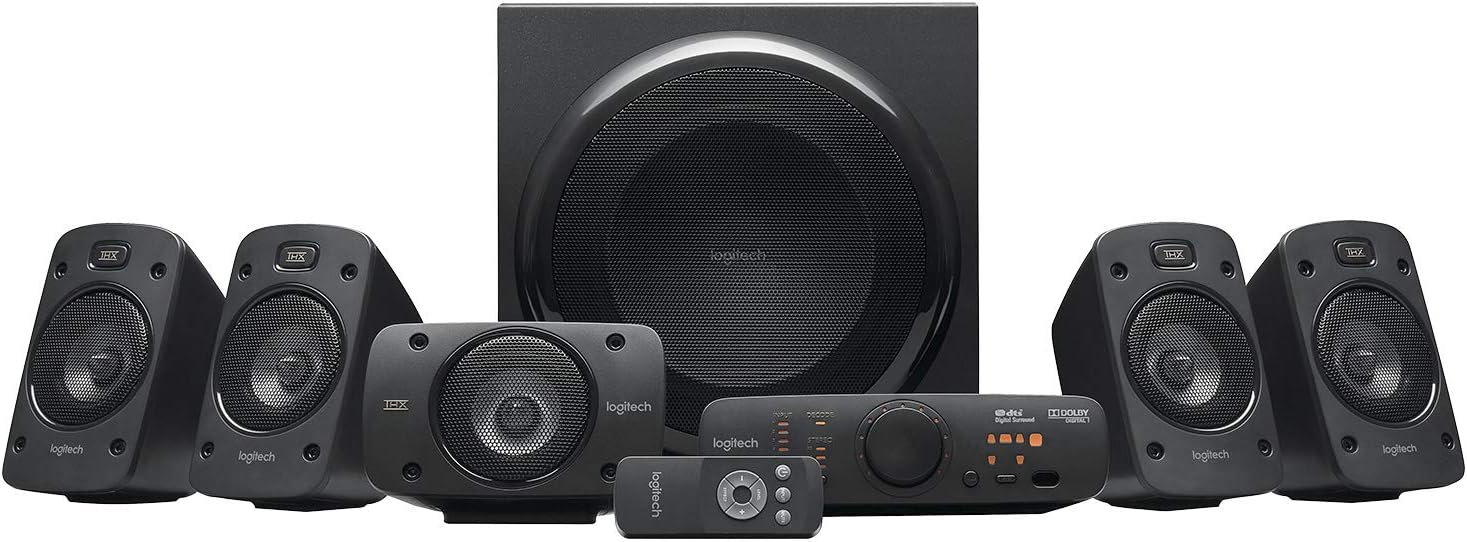
The Z906 has been around long enough that calling it a veteran is an understatement.
It stays on this list for one reason that hasn’t changed: THX-certified zero-latency wired performance. For competitive gaming and PC audio, that matters more than wireless convenience.
1000W peak power, six simultaneous inputs including 3.5mm, RCA, optical, and six-channel direct, and the ability to connect a PC, console, and TV at the same time without switching cables.
No Wi-Fi setup, no pairing process, no interference. Just plug in and get audio.
The tradeoff is format support. The Z906 doesn’t decode Dolby Atmos or DTS:X, and there’s no HDMI input. For gaming and PC use, that’s acceptable. For a dedicated home theater setup, it’s a meaningful limitation.
- Specs: 5.1 channels, 1000W peak power, THX certified, wired speakers
- Formats: Dolby Digital, DTS Digital Surround
- Connectivity: 3.5mm, RCA, six-channel direct, digital optical
Pros:
- THX certification and wired connection means no audio lag, which is critical for competitive gaming
- Six simultaneous inputs lets you connect multiple sources without unplugging anything
- 1000W peak power for desk-based or mid-size room gaming setups
Cons:
- No Dolby Atmos or DTS:X support, which is a real gap for movie-focused use
- No HDMI; relies on optical or analog inputs
Verdict: The PC gaming standard for a reason. If you want surround sound at your desk with zero latency and zero pairing hassle, the Z906 is still the benchmark.
7. Sonos Arc Ultra + Sub 4 + Era 100 (Pair)
The Best Premium Wireless Ecosystem

The Sonos approach is different from every other system on this list.
Most soundbar companies build a box that does surround sound.
Sonos builds an ecosystem, one where the soundbar, subwoofer, and rear speakers are individual products that work together through Wi-Fi 6, and where adding a speaker to another room is a settings toggle rather than a rewiring project.
The Arc Ultra’s Sound Motion transducers deliver low-frequency response from a cabinet that looks like a design object rather than a piece of AV equipment.
Pair it with the Sub 4’s vibration-canceling design and Era 100 rears, and you get a modular 7.1.4 system that also functions as a whole-home audio platform.
Trueplay calibration, AirPlay 2, and Apple Spatial Audio support make this the obvious pick for households deep in the Apple ecosystem.
- Specs: Modular 7.1.4 (estimated), Sound Motion transducers, Wi-Fi 6, Bluetooth 5.3
- Formats: Dolby Atmos, Apple Spatial Audio, Trueplay room calibration
- Smart Features: Sonos Voice Control, AirPlay 2, multi-room audio syncing
Pros:
- The Sonos app is the best in the industry: genuinely easy to configure, reliable, and updated regularly
- Era 100 rears hold up for critical music listening, not just movie surround
- Sub 4 delivers clean, deep bass without floor-rattling vibration at moderate volumes
Cons:
- Bundled cost is the highest on this list
- No HDMI passthrough on the Arc Ultra, which is a limitation that matters if you’re running multiple HDMI sources
Verdict: If design, software polish, and multi-room streaming matter as much as raw surround performance, nothing else competes. Apple users, especially, will find the ecosystem integration hard to give up once they’ve used it.
Comparison Table: 2026 Home Audio Systems
System
Max Power
Channels
Connectivity
Best For
Samsung Q990F
656W
11.1.4
Wireless Atmos / HDMI
Large living rooms
Sonos bundle
N/A
7.1.4
Wi-Fi 6 / AirPlay 2
Music and design
JBL Bar 9.1
820W
5.1.4
Detachable rears
Renters
Ultimea D60
410W
5.1
HDMI eARC
Small budgets
Klipsch Reference
1000W+
5.1.2
Wired (requires AVR)
Audiophiles
Hisense AX5140Q
500W
5.1.4
HDMI eARC
Atmos value
Logitech Z906
1000W
5.1
Optical / analog
PC gaming
How to Choose the Right Home Audio System

Understanding Channel Configurations
2.1 is two speakers plus a subwoofer, which is fine for music but thin for movies. 5.1 adds a center channel for dialogue clarity and two rear speakers for surround, and this is the baseline for a real surround experience.
7.1.4 is the current high-end standard: four height channels create a three-dimensional sound field where audio moves above you, not just around you.
The “.4” is the difference between hearing an overhead helicopter and feeling like it’s passing over your head.
Wired vs. Wireless Audio
In 2026, wireless audio quality has genuinely caught up for home theater use. The Samsung Q990F and Sonos Arc Ultra transmit lossless audio wirelessly without the dropouts and compression artifacts that plagued earlier systems.
The one exception remains competitive gaming. For zero-latency audio where a 20ms delay costs you a kill, wired systems like the Logitech Z906 are still the right call.
HDMI eARC: Check Before You Buy
HDMI eARC (Enhanced Audio Return Channel) lets your TV send high-bandwidth, uncompressed Dolby Atmos audio to your soundbar over a single HDMI cable. Without it, you’re limited to compressed audio formats that can’t carry the full Atmos data stream.
Every system on this list except the Klipsch and Logitech has eARC. If you’re buying either of those, check your TV’s HDMI spec sheet.
Matching Subwoofer Size to Room Size
A 6.5-inch or vibration-canceling subwoofer (like the Sonos Sub 4) works well in apartments and smaller rooms, delivering deep bass without structural vibration that transmits through shared floors and walls.
For large, open-plan living areas or dedicated theater rooms, a 10-inch or 12-inch driver (JBL, Klipsch) produces the low-frequency extension that actually fills the space.
Final Recommendations
If you want the best all-in-one home cinema system and own a Samsung TV, the Q990F is the clear answer. The wireless Atmos and Q-Symphony integration are genuinely differentiated features.
If you use Apple devices, care about music as much as movies, and want a system that also covers multi-room audio, the Sonos Arc Ultra bundle is worth the premium.
If your budget is tight and you want your first real surround sound experience over TV speakers, start with the Ultimea Poseidon D60. Physical rear speakers at that price point are hard to find.